
Deploying Real-Time Threat Detection with Generative AI
Learn how to stitch open‑source large language models into a cloud‑native SIEM pipeline for instant anomaly scoring, a timely defense against today’s ransomware surge.
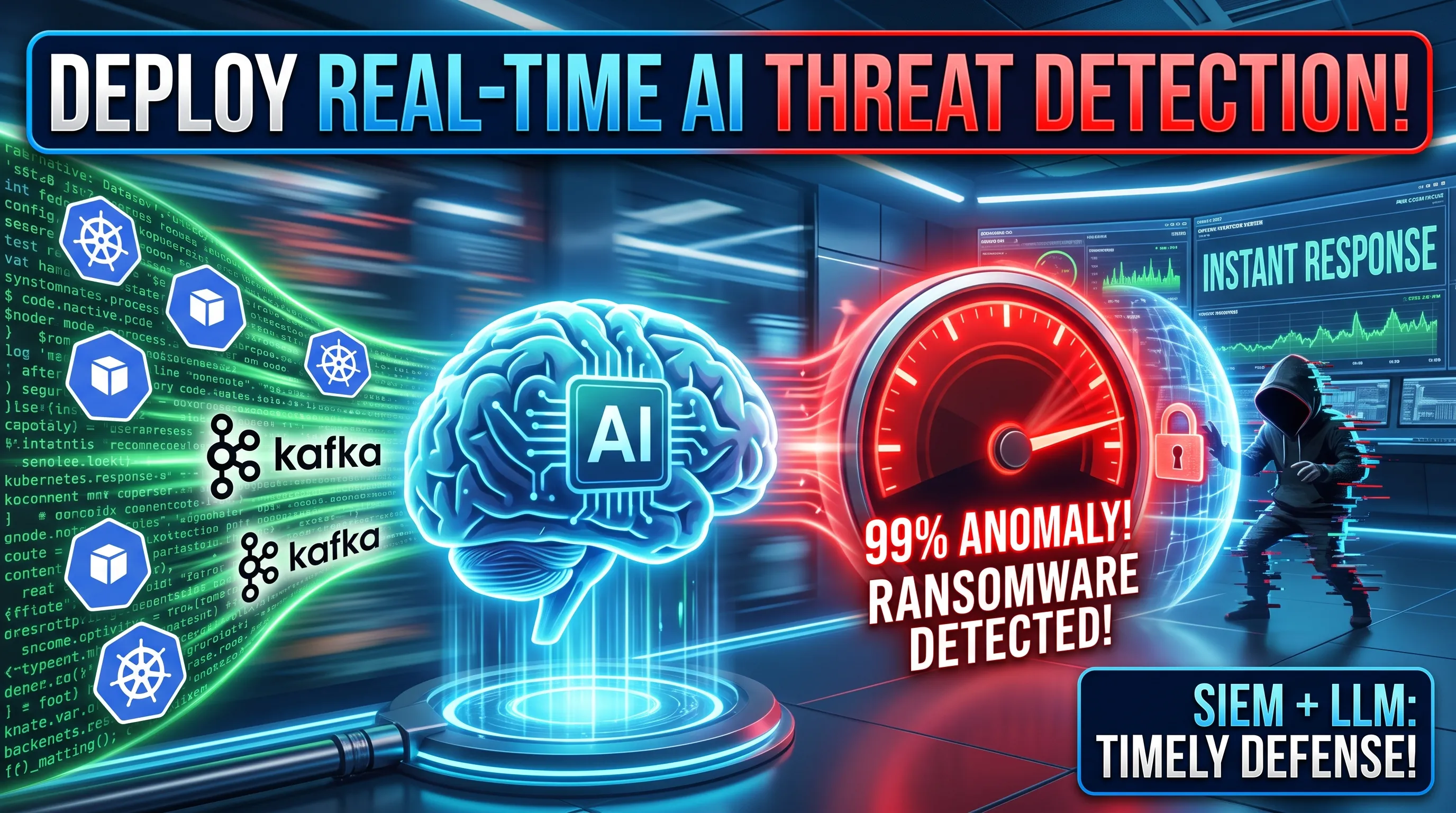
Why Real-Time Threat Detection Matters Now
Ransomware operators have shifted from blunt, periodic attacks to continuous, multi‑vector campaigns that blend phishing, supply‑chain compromise, and credential stuffing. The speed at which an intrusion can move from initial foothold to data encryption leaves traditional batch‑oriented security analytics trailing behind. At the same time, the release of the latest generative AI models—most notably GPT‑5—has sparked a wave of interest in AI‑augmented defenses that can reason about novel patterns as they appear.
Organizations that can score events in seconds, rather than minutes, gain a decisive advantage: they can quarantine containers, rotate secrets, or trigger automated remediation before the attacker reaches critical assets.
- Ransomware attacks have risen in frequency and sophistication.
- Cloud‑native workloads generate massive, high‑velocity logs.
- Generative AI models can infer intent from sparse or noisy data.
Core Concepts: Generative AI, LLMs, SIEM, and Cloud‑Native Architecture
Generative AI and Open‑Source LLMs
Large language models (LLMs) such as LLaMA, Mistral, or Falcon are now available under permissive licenses, allowing security teams to run inference on‑premise or within a private VPC. These models excel at pattern completion, contextual reasoning, and even code generation, making them suitable for translating raw log streams into structured threat indicators.
SIEM and Anomaly Scoring
A Security Information and Event Management (SIEM) platform aggregates logs, normalizes fields, and correlates events across the environment. Traditional SIEM rules rely on static signatures or threshold‑based heuristics. By feeding normalized events to an LLM, you can obtain a probabilistic “anomaly score” that reflects how likely an event deviates from learned benign behavior.
Cloud‑Native Architecture Basics
Modern workloads run in containers, serverless functions, and managed services. Observability pipelines typically use event streams (Kafka, Pulsar) and log aggregation layers (Elastic, Loki). Leveraging these existing components reduces integration friction and keeps latency low.
Building the Pipeline – Step by Step
1. Data Ingestion from Cloud Services
Start with a lightweight collector (Fluent Bit or Vector) that streams logs from Kubernetes pods, API gateways, and cloud audit trails into a message broker such as Apache Kafka. Ensure each message carries a timestamp, source identifier, and raw payload.
2. Normalization and Enrichment
Deploy a stream processor (Kafka Streams, Flink, or Spark Structured Streaming) to map raw fields to a common schema (e.g., the Elastic Common Schema). Enrich events with asset metadata—owner, criticality, and known vulnerabilities—by joining against a CMDB stored in a key‑value store.
3. Real‑Time Scoring with an LLM
Within the same streaming job, invoke the LLM via an HTTP‑compatible inference server (vLLM, Text Generation Inference, or an OpenAI‑compatible endpoint). Pass a concise JSON representation of the event and a prompt such as:
{
  "prompt": "Given the following log entry, assign an anomaly score from 0 (benign) to 100 (highly suspicious). Explain briefly.",
  "event": {"source":"k8s","message":"Failed login for user admin from 10.2.3.4"}
}
The model returns a score and a short rationale, which you attach back to the event record.
4. Feedback Loop and Model Fine‑Tuning
Security analysts review high‑scoring alerts in the SIEM UI. Their confirmations (true positive, false positive) are written to a feedback topic. Periodically, you aggregate this feedback to fine‑tune the LLM on domain‑specific data, improving precision over time.
5. Alerting and Automation
Finally, route scored events to the SIEM’s rule engine. When the anomaly score exceeds a configurable threshold, automatically create a ticket, isolate the offending pod via a Kubernetes NetworkPolicy, or invoke a serverless function that rotates the compromised secret.
Hands‑On Example Using Open‑Source Tools
The following minimal pipeline demonstrates the core ideas using freely available components. Adjust paths and credentials to match your environment.
- Kafka – event backbone
- Fluent Bit – log collector
- Elastic SIEM – storage and visualization
- vLLM – low‑latency LLM server (e.g., LLaMA‑2‑7B)
- Kafka Streams (Java) – processing and scoring
Key code snippet (Kafka Streams processor):
public class AiScorer implements Processor<String, String> {
    private HttpClient http;
    private String endpoint = "http://vllm:8080/v1/completions";
@Override
public void init(ProcessorContext context) {
    http = HttpClient.newHttpClient();
}

@Override
public void process(String key, String value) {
    // 1. Parse raw log into JSON (omitted for brevity)
    JsonObject event = parseLog(value);
    // 2. Build prompt
    JsonObject payload = new JsonObject();
    payload.addProperty("prompt", "Assign an anomaly score (0‑100) and a short reason.");
    payload.add("event", event);
    // 3. Call LLM
    HttpRequest request = HttpRequest.newBuilder()
        .uri(URI.create(endpoint))
        .header("Content-Type", "application/json")
        .POST(HttpRequest.BodyPublishers.ofString(payload.toString()))
        .build();
    try {
        HttpResponse<String> resp = http.send(request, HttpResponse.BodyHandlers.ofString());
        JsonObject result = JsonParser.parseString(resp.body()).getAsJsonObject();
        // 4. Attach score and forward
        event.addProperty("ai_score", result.get("score").getAsInt());
        event.addProperty("ai_reason", result.get("reason").getAsString());
        context.forward(key, event.toString());
    } catch (Exception e) {
        // In production, handle retries and back‑off
    }
}

@Override
public void close() {}

}
Deploy the processor as part of a Kafka Streams topology, then point Elastic SIEM’s ingest pipeline to the output topic. Within minutes you will see a new field ai_score on every event, ready for threshold‑based alerts.
Operational Considerations
Running generative AI in a security context introduces new trade‑offs. Below are the most common factors to monitor.
- Latency – Real‑time detection demands sub‑second inference. Choose a model size that fits your hardware budget; quantized 4‑bit models often hit <200 ms per request on a single GPU.
- Cost – Inference at scale can consume significant compute credits. Batch multiple events per request when possible, and leverage spot instances for non‑critical workloads.
- Model Drift – Attack techniques evolve faster than static LLM knowledge. Regular fine‑tuning on recent incident data keeps the model relevant.
- Security of the Model – The LLM itself becomes an asset. Protect the inference endpoint with mutual TLS and restrict network access to the processing layer.
- Compliance – Ensure that logs containing personally identifiable information (PII) are either redacted before reaching the model or that the model runs within a compliant jurisdiction.
Future Outlook
As foundation models grow more capable, the line between detection and response blurs. Upcoming releases promise native code‑generation abilities that could automatically craft containment scripts, while multimodal models may ingest network flow diagrams alongside logs for richer context. Organizations that invest in a modular, open‑source pipeline today will find it easier to adopt these advances without re‑architecting their entire SOC.
In short, integrating generative AI into a cloud‑native SIEM stack transforms raw telemetry into actionable insight at the speed attackers demand. The approach is still evolving, but the building blocks are mature, freely available, and ready for production use.
How can I start experimenting with AI‑enhanced threat scoring without impacting production?
Set up a parallel staging environment that mirrors your production log streams, run the LLM inference server on a modest GPU, and configure the SIEM to ingest the scored events into a separate index. This lets you tune prompts, thresholds, and feedback loops safely before any live alerts are generated.
Related posts
View allPassword Generator: How to Create a Strong Password
Reused passwords are the easiest way into an account. Generate a long random password or a memorable passphrase and store it properly.
Zero‑Trust Network Access for Remote Teams: A Practical Open‑Source Guide
Learn how small‑to‑medium businesses can adopt open‑source Zero‑Trust solutions to protect distributed workforces with minimal cost and complexity.
Deploy a Secure Zero‑Trust Network for Hybrid Teams with Cloudflare ZTNA
Learn how to build a high‑performance, cloud‑native zero‑trust perimeter for remote and on‑site staff using Cloudflare ZTNA, step by step.
Comments (1)
Das
Ghkknhf